Latest Project
TRUMP AND REALITY
Published January 26, 2026
Donald J. Trump’s presidency is the greatest threat to American democracy, to its Constitutional government, and to its national security since World War II.
Trump acts and speaks as if he were a dictator like Adolf Hitler or Josef Stalin, unconstrained by anything or anyone but himself. “My own mind….it’s the only thing that can stop me,” he told The New York Times in a long interview session early this month.
Trump’s view of the world came across as a megalomaniacal mishmash in two seemingly endless televised public appearances this past week, in the White House in Washington and then at the World Economic Forum in Davos on Wednesday. Then he inaugurated a “Board of Peace,” with himself as its all-powerful chief, to help him reshape the world as he thinks it should be, starting by rebuilding war-torn Gaza.
All this left most of the European leaders in Davos in a state of shock. France, Sweden, and Norway said they would not join the new organization, which they fear Trump will use to replace the NATO alliance. But 23 other countries agreed, even though a permanent seat costs $1 billion.
This President is unlike any other the Europeans have had to deal with in the past 75 years, one who acts on his own constantly changing feelings and impressions more than on facts.
NATO? A collection of countries who spend too little for their own defense and parasitically depend on U.S. military might to protect them if Russia or China attack. He forced all NATO countries last year to agree to spend more, getting to 5 percent of GNP every year by 2031. The United Nations? The “Board of Peace” could supersede that, too.
Last year he imposed a blizzard of tariffs on imports from countries around the world to force them to do what he demands. He never showed a hint of awareness that it is Congress, not the President, that the Constitution authorizes “to lay and collect Taxes, Duties, Imposts and Excises.” He just went ahead, and the Republican majorities in Congress let him get away with it.
This month he was threatening to slap even higher tariffs on goods from Denmark and countries that supported its refusal to sell or give to the U.S. the vast, strategically situated ice-covered island of Greenland, controlled by Denmark since 1721 and, in our time, a county of that kingdom itself. He threatened to send thousands of U.S. troops to seize it, to keep Russia and China out and to build an advanced Golden Dome anti-missile defense system to shoot down any rockets they could fire at us over the North Pole.
To Norway’s President, Jonas Gahr Store, he texted that not getting the Nobel Peace Prize was one reason why he would try to take Greenland by force if Denmark wouldn’t sell. Here’s what he wrote on his Truth Social Jan. 18:
"Dear Jonas,
Considering your Country decided not to give me the Nobel Peace Prize for having stopped 8 Wars PLUS, I no longer feel an obligation to think purely of Peace, although it will always be predominant, but can now think about what is good and proper for the United States of America. Denmark cannot protect that land from Russia or China, and why do they have a ‘right of ownership’ anyway? There are no written documents, it’s only that a boat landed there hundreds of years ago, but we had boats landing there, also."
Never mind that it is the Nobel Committee, not the government of Norway, that awards the prize: a U.S. attack on Denmark, a fellow member of NATO, would destroy the alliance that for decades deterred aggression by the Soviet Union and now Russia. Trump’s reckless threats have shocked all of NATO’s European countries into realizing that they are now on their own with the Russians, as vulnerable as Ukraine was when Vladimir Putin invaded in 2022.
Arriving in Davos Jan. 21, the President at first repeated his threats to use stiff tariffs and troops to take Greenland if Denmark wouldn’t let him have it. Then he had what he called a “very productive meeting” with NATO Secretary-General Mark Rutte, and said his aides would try to work out an agreement. It’s not clear if they can if the United States insists on its own sovereignty on any bases it might rebuild or establish there.
If he were a rational man, he might have gotten almost everything he wanted peacefully, under the 1951 treaty between the United States and Denmark, still in effect, that allowed the U.S. to keep the dozen bases it had set up to defend Greenland during World War II? The Americans shut down all but one of them after the Soviet Union collapsed in 1991, but that one, the missile-defense Pituffik Space Base, is still operating and would probably be part of the Golden Dome system he wants to build.
Trump’s endless rambling monologues show that he believes not in trust or advice from allies or interlocutors, but in his own infallibility. He is not infallible; he is ignorant. He acts as if he thinks he knows all he has to know better than anyone else. So his blathering in Davos has left the European leaders listening there shocked and shaken.
What about Congress? Only a few Republicans in either house spoke out against his threats to use force on Greenland -- Republican Mike Turner, Representative from Ohio, Senator Thom Tillis of North Carolina, and Senator Rand Paul of Kentucky among them.
The Democratic opposition on Capitol Hill has been ineffectual, though it could gain strength if enough voters in the midterm elections later this year remember Trump’s frightening warlike threats and give them a majority.
Just in the past year, Trump has demolished whole government departments, dismissed tens of thousands of government employees, deprived millions of Americans of affordable government health insurance, and run up the already-colossal government spending debt, to $38.47 trillion, which could be $2.4 trillion higher by the end of this year.
Perhaps this will all stop with the 2028 national election, when he can’t run for the presidency again because of the 22d Amendment to the Constitution, barring anyone from being elected President more than twice.
But I wouldn’t bet on that. For that matter, I wouldn’t be surprised if he tried to stay on even without an election.
Last August, in a press conference after a meeting with Volodymyr Zelensky, the Ukrainian leader mentioned that elections there were suspended because of the war with Russia, and Trump perked up.
"So let me just say, three and a half years from now, so you mean if we happen to be in a war with somebody, no more elections? Oh, that’s good. I wonder what the fake news is going to say."
Trump recognizes elections –but only when he wins. He still insists, as he did again in Davos, that the Democrats had rigged the 2020 election against him, and that actually he had won. He said there would soon be prosecutions to prove him right.
We have a President whose mind is disconnected from reality.
God help us all.
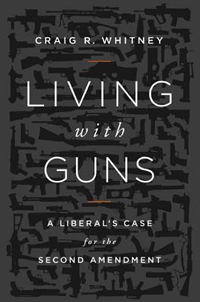
Living With Guns: A Liberal’s Case for the Second Amendment
Published November 13th, 2012
Americans own as many as 300 million guns, and about 30,000 of us die from gunshots every year. Even though about two-thirds of such deaths are suicides, the number of murders is shocking. Furthermore, the disturbing phenomenon of mass shootings by psychopaths who are able to obtain guns legally continues. On Memorial Day weekend, Elliot O. Rodger, a disturbed 22-year-old former college student in Isla Vista, California, stabbed three people to death and then, with three semi-automatic pistols and hundreds of rounds of ammunition, went on a shooting spree that killed three more and wounded 13 before he killed himself.
Can we really “live with guns?” Yes we can, but only if we can find a way to talk reasonably with each other about them rather than shouting slogans, which is what we have been doing in the culture wars we have been waging with each other over the Second Amendment to the Constitution.
“Living With Guns” argues that the Second Amendment recognizes and protects an individual’s right to own and use guns. Americans have had that right since colonial days, but we tend to forget that it has always been connected with a civic duty. Back then it was to come to the common defense when called by the local or state militia. After the Revolution, the founders recognized the right to keep and bear arms as an important guarantee that the powerful federal government they established with the Constitution could not use a standing federal army to impose tyranny over the states and their militias, or on individual Americans. Like all other rights, the right to own guns was not unqualified and was subject to reasonable regulation, as it had been since Jamestown and Plymouth Rock.
But times changed. Social and racial turbulence in the 1960s was followed by a wave of drug use and violent crime. Under the banner of being “tough on crime,” Conservatives urged and passed “stand your ground” laws in many states, giving people greater license to look to their own guns for self-defense. Meanwhile more liberal areas like Washington, D.C. and Chicago, afflicted with high murder rates in those troubled times, in effect banned gun ownership in an effort to bring them down. But the bans did not work. And gun bans are not constitutional, according to the conservative majority in the Supreme Court, in opinions in 2008 on Washington’s law and in 2010 on Chicago’s (and for that matter, others nationwide). In Living With Guns I make the case that history shows that the justices were right on that point, though wrong in their more sweeping assertion that the primary purpose of the right was self-defense.
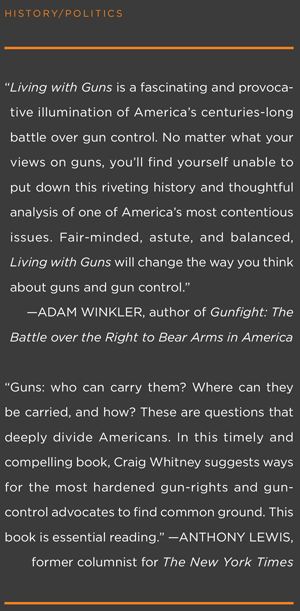
They also ruled that reasonable gun control laws were constitutional. But strict gun control by itself cannot solve our gun violence problem. Keeping guns out of the hands of as many law-abiding Americans as possible does not keep them out of the hands of criminals who do not bother to register guns at all. Draconian gun laws and regulations do not work as well as social and economic policies that work with, rather than against, violence-prone young people in troubled neighborhoods -- for example, those programs that endeavor to convince them that using guns is not a solution to frustration.
Reasonable gun regulations are on the books, but they are full of loopholes. Everybody agrees that people convicted of crimes, the mentally unstable, those addicted to drugs, people subject to restraining orders against a spouse, and the like should not have guns, and Federal law forbids licensed dealers from selling to them. But the Federal background check database of names is full of holes. Other loopholes in the law allow private individuals to sell guns with no background checks at all on buyers.
Conservatives and the NRA fight all efforts to tighten the regulations, as if the crime wave of 20 and 30 years ago had not significantly ebbed, along with the crack-cocaine epidemic that caused much of it. “Stand your ground” laws that make it easier for people who have guns to use them when they feel threatened, like the one invoked by the neighborhood watch volunteer in Florida who shot Trayvon Martin to death in 2012, do nothing to reduce gun violence by criminals.
All Americans should be encouraged to recognize that gun ownership is a right, but that gun owners still have a civic duty, to exercise the right carefully and responsibly, not recklessly. The current impasse makes the next gun massacre simply a matter of time. “Living With Guns” explores ways to make it possible for Americans to live in greater safety, even with so many guns around.
- Purchase from Amazon
- Purchase from Barnes & Noble
- Purchase from IndieBound
- Purchase from Powell's Books
The Author’s Proposals To Increase Public Safety
All of the recommendations in “Living With Guns” on how to make it safer for all of us to live with guns turned up in one form or another in the package of legislative and executive measures proposed by President Obama on Jan. 16, after the Newtown massacre.
See the proposals as they appear in Chapter Eight of the book, where the reasons for them are fully explained. READ MORE HERE.